Guides · Doubles practice · 11 min read
Darts doubles practice: how to hit more doubles
You hit more doubles by aiming at one small spot in the bed, keeping the same relaxed throw you use on the treble 20, and practising with drills that keep score. Leave doubles that halve when you miss, such as 32, and track your hits per dart so you can see the practice paying off.
In short
- Checkout rate is finishes divided by darts at a double. It decides close legs.
- Aim at one spot in the middle of the bed and keep your normal throw.
- Leave 32 or 40, so a dart in the single still leaves a double.
- Practise with a score: Bob’s 27, doubles round the clock, 121 and Checkout King.
- Four weeks of 15 minutes a day, with the same drills, show you real progress.
Checkout rate
Why do doubles decide legs in darts?
Every leg of 501 with double out ends on a double, so the player who needs fewer darts at the double usually takes the leg. Two players with the same scoring can be several visits apart once they reach a finish.
Your checkout rate measures exactly this: finishes divided by the darts you threw at a double with a finish on. At 25 % you need four darts per finish on average. At 10 % it is ten darts, more than three visits.
Your chance to check out within one visit
How the numbers are worked out. Three misses in a row happen with (1 − rate)³, so a visit of three darts at a double checks out with 1 − (1 − rate)³. Real visits only roughly follow this, but the jump from 20 % to 30 % is clear.
The guide to the darts average explains what counts as a checkout attempt and what rates look like at different levels.
Aiming
How do you aim at a double?
Aim at one small spot in the middle of the double, not at the whole bed. Then throw the same throw you use on the treble 20, with the same rhythm and the same follow-through.
- Pick a spot. A hole in the sisal or the centre of the bed. A small target tightens your grouping more than a big one.
- Keep your tempo. A careful, slowed down throw tends to drop low. Throw at the double as freely as at the treble.
- Finish the throw. Let your arm follow through towards the spot, as in the guide on how to throw darts.
- Same routine every time. Breathe out, look at the spot, throw. The routine travels with you into a match.
Top doubles or side doubles?
A double is only about 8 mm deep but over 50 mm long. At the top and bottom of the board, as on D20 and D3, it lies flat. At the sides, as on D6 and D11, it stands upright.
Many players spread more up and down than sideways, because a slightly early or late release changes the height of the dart. For them the side doubles are the bigger target. The top doubles still forgive their misses: high stays outside the board, low leaves the single.
The catch on the side doubles. A big miss up or down lands in the next double along, and on a small score that can bust you. Your own spread decides, so check your heatmap before you pick favourites.
Staying on a finish
Which doubles leave another double when you miss?
Doubles that halve keep you on a finish when the dart drops into the single. From 32 (D16) the chain runs 16, 8, 4 and 2, which is why 32 is the favourite leave and 40 (D20) the other classic.
- From 32 you can drop into the single four times and still have a double.
- From 40 the third single leaves 5, an odd number. That costs a dart: 1, then D2.
- Next door to D16 are the 8 and the 7. A single 8 from 32 leaves 24 (D12), a single 7 leaves an awkward 25.
The checkout chart has more on preferred doubles, odd numbers and the dreaded D1.
Drills
Which doubles drills work best?
The best doubles drills end with a number you can beat next time. These six cover every double, the halving leaves and short finishes, and two or three of them fill a 15-minute block.
- Bob’s 27D1 to D20 and the bullseye, starting on 27 points. A hit adds the double’s value, a blank round takes it off. Score: points. First goal: get through all 21 rounds.
- Doubles round the clockD1 to D20, then the bullseye, as many darts as it takes. Score: darts needed. Divide by 21 and you have your darts per double.
- The halving chainTen finishes from 32, played like a real leg: a single leaves the next double down. Score: darts for all ten. At a 25 % double rate that is about 40.
- Three in a bedTen visits at one double. Each dart in it scores 1, all three in the bed add 5. Score: out of 80. Grouping on one double builds a favourite you trust.
- 121Check out 121 in nine darts, then go up one. Miss and you drop back to your checkpoint. Score: the highest number you check. Trains setup visits and doubles together.
- Checkout King on 2 to 40A random double finish every visit, three darts each. Every check adds to your streak, a miss resets it. Score: longest streak.
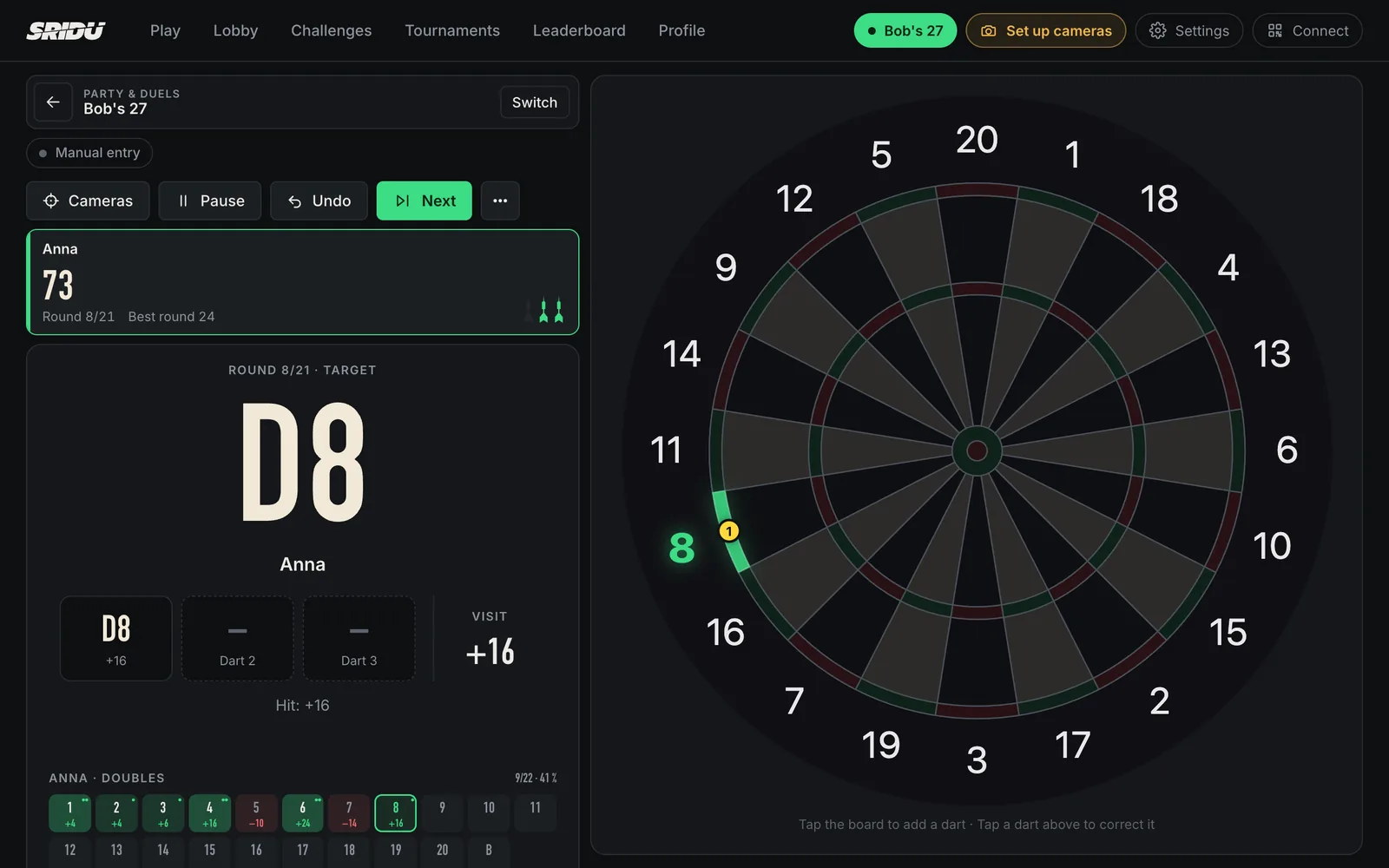
Bob’s 27, doubles round the clock, 121 and Checkout King are all training modes in Sridu, so the app counts for you and keeps a record for every setting. The halving chain and three in a bed only need a pen. The darts practice app page shows every drill the app has.
Make round the clock harder. With setback on, a visit without a hit sends you one double back. With three strikes, the third blank visit ends the run.
Pressure
How do you practise doubles under pressure?
Put something at stake on every dart, because a double in a match feels nothing like a double in practice. Drills that end or reset after one miss come closest.
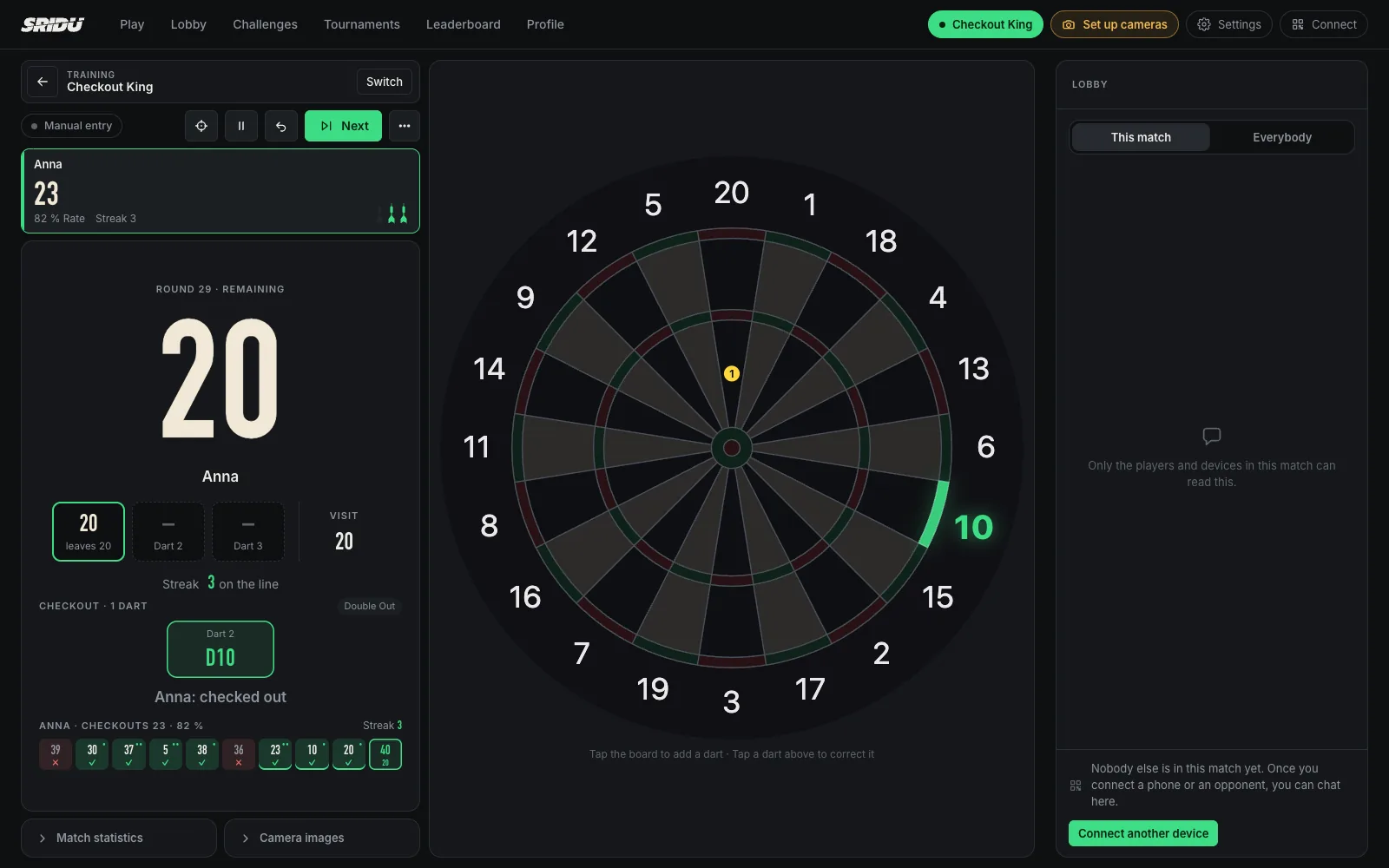
- Sudden deathCheckout King on 2 to 40 with sudden death. The first missed finish ends the run.
- Ten match dartsOne dart at a double, pull it, walk back and go again. Score out of ten, like ten darts for the match.
- StrikesDoubles round the clock with three strikes, so blank visits start to hurt.
- A real opponent501 against a friend or a computer opponent at your level. Every missed double gives them a shot.
If your arm tightens on the double, the darts mental game guide has routines for exactly that moment.
4-week plan
A four-week plan for doubles and checkouts
Add 15 minutes of doubles to your normal practice on five days a week and keep the drills the same for four weeks. Week 1 sets your baseline and the last day of week 4 repeats it, so the two numbers compare fairly.
| Week | 15 minutes a day | Write down |
|---|---|---|
| 1 · Baseline | Bob’s 27 once, doubles round the clock once | Bob’s 27 score, darts round the clock |
| 2 · Every double | Bob’s 27 or round the clock on alternate days, then three in a bed on your weakest double | Three in a bed score |
| 3 · Finishes | The halving chain, then Checkout King on 2 to 40 | Darts for the chain, longest streak |
| 4 · Pressure | Checkout King with sudden death, ten match darts. Last day: repeat week 1 | Streak, match darts out of ten, both week 1 numbers |
- 15 minutesRoughly 60 to 90 darts at doubles, enough to see a rate without tiring your arm.
- Same settingsChange a drill’s settings and its numbers no longer compare with last week’s.
- Weakest doubleThe one your heatmap shows the most misses on gets the three in a bed slot.
Checkout routes
How do you learn darts checkouts?
Learn checkouts as patterns instead of 160 separate numbers. Subtract the double you want to leave, and the rest is what your first dart or two must score.
| Left | Minus | Rest | Route |
|---|---|---|---|
| 88 | 40 (D20) | 48 = T16 | T16 D20 |
| 86 | 32 (D16) | 54 = T18 | T18 D16 |
| 70 | 16 (D8) | 54 = T18 | T18 D8 |
| 57 | 40 (D20) | 17 | 17 D20 |
| 37 | 32 (D16) | 5 | 5 D16 |
| 29 | 16 (D8) | 13 | 13 D8 |
- 41 to 60Throw the single that leaves 40. Most players make two exceptions: 48 goes 16 D16, 50 is the bull.
- 61 to 100A treble, then the double. If the rest is no treble, try the next anchor down.
- Say it firstCall your route out loud before the visit, then compare it with the chart or the app.
When no finish is on, use your darts to leave 32 or 40 for the next visit. The checkout chart and calculator lists the usual route for every score from 170 down and shows the best setup when you can’t finish.
Drill the routes, not just the doubles. 121 and Checkout King on 41 to 98 are two-dart finishes over and over. In an X01 leg, Sridu shows the way out for the darts you have left after each throw.
Tracking
How do you measure progress on your doubles?
Track your double rate, the hits divided by the darts you threw at a double. Compare a few weeks with the weeks before, because a single evening swings a lot.
- Double rate in drills shows your skill without pressure.
- Checkout rate in matches shows it with pressure. A big gap between the two usually points to nerves, not aim.
- Where the misses go tells you what to fix. Mostly inside the wire often means a short follow-through.
Sridu keeps all of this in your statistics: the double rate from X01 legs and the doubles drills, the checkout rate, a heatmap and every drill record, over 30 days, 90 days or all time.
FAQ
Questions about doubles practice
What is a good checkout percentage in darts?
As a rough guide, 15 to 25 % per dart is common at pub level, and the best players often reach around 40 % over a match. More useful than any table is your own rate, compared over weeks.
Which double is the easiest to hit?
All doubles are the same size. Which one suits you depends on the shape of your spread: up and down favours the side doubles, sideways favours the top and bottom. D16 and D20 are the most popular because of what a miss leaves.
Should I aim at the inside or the outside of the double?
Aim at the middle. On 32 or 40 both misses are fine, because a dart outside changes nothing and a single leaves another double. On 2 left a single 1 busts you, so many players favour the outer half of D1.
How long should I practise doubles each day?
About 15 focused minutes on five days a week, roughly 60 to 90 darts. Throw them while you are fresh, before long scoring blocks tire your arm.
Is Bob’s 27 or doubles round the clock better?
Use both. Bob’s 27 puts points at stake on every double and punishes blank rounds, while round the clock simply counts the darts you need. Together they show your pressure game and your raw rate.
Can I practise doubles without cameras?
Yes. In Sridu you can tap each dart on the board on screen and every drill still counts, heatmap included. A pen and paper work for the halving chain and three in a bed.
Why do I miss doubles in matches but hit them in practice?
In a match the dart matters, so your throw tends to get tight and slow. Practise with something at stake, such as sudden death or ten match darts, and keep the same routine before every dart at a double.
Guides
Related guides
Practise your doubles with a score
Open Sridu in your browser and start Bob’s 27, doubles round the clock or Checkout King. The app counts every dart and keeps your double rate and records. No account, nothing to install.