Guides · Darts rules · 15 min read
Darts rules explained simply: 501, double out and bust
Darts rules in short: each player throws three darts per turn from behind the oche and takes the score off 501. The first to reach exactly zero with the last dart in a double or the bullseye wins the leg, and a turn that goes below zero, leaves 1 or ends without a double is bust and counts nothing.
In short
- Turn: three darts, added up and taken off your score.
- Goal: from 501 down to exactly zero.
- Finish: the last dart in a double or the bullseye.
- Bust: below zero, 1 left or zero without a double. Back to where the turn began.
- Who starts: a bull-off, then the start alternates every leg.
- To print: the darts rules as a PDF, one A4 page.
At a glance
What are the basic rules of darts?
Darts is almost always 501 double out: count down from 501 and finish on a double. The rules on this page are those of the World Darts Federation (WDF), and the PDC plays the same basics.
- Three darts a turnThrown one at a time, by hand, point first. A turn is also called a visit.
- Count down from 501Add up the three darts and take the total off what you have left.
- Finish on a doubleThe last dart must hit the double that makes exactly zero, or the bullseye for 50.
- BustToo many points, 1 left or zero without a double: the whole turn counts nothing.
- Bull-offOne dart each at the bull. The dart nearer the centre throws first.
- Legs, sets, matchA leg is one game of 501. Legs make sets, and legs or sets decide the match.
Learning to play for the first time? The guide on darts for beginners covers kit, throw and a first month of practice. This page is the rule book to keep next to it.
Scoring
How do you score points in darts?
A dart scores the number of the segment it sticks in. The thin outer ring counts double, the thin inner ring treble, the outer bull 25 and the bullseye 50.
| What happens | What it scores |
|---|---|
| Dart in a single bed | the number |
| Dart in the double ring | twice the number |
| Dart in the treble ring | three times the number |
| Outer bull / bullseye | 25 / 50 |
| Point right on a wire | the bed the point went into |
| Outside the double ring | 0 |
| Bounces out or falls out before the score is taken | 0, and it may not be thrown again |
The darts stay in until the score is called. Pushing a dart in or holding it so it does not fall out is not allowed, and a dart touched that way does not count. If you touch a dart in the board during your turn, that turn is over.
A points table, worked examples and how to keep score on a chalkboard are in the guide on how to score darts.
Sources: WDF Playing and Tournament Rules, 20th edition, rules 1.03 to 1.07 and 3.02 to 3.03.
The game
How does 501 work in darts?
Every player starts on 501 and takes each turn off that score. The first to reach exactly zero, finishing on a double, wins the leg.
301 and 701 follow the same rules with a different starting score.
- TurnDartsScoredLeft
- 1T20 · T20 · 20140361
- 220 · T20 · 181280
- 3T20 · 5 · T20125155
- 4T20 · T19 · 111837
- 55 · 16 · 8298
- 68bust8
- 7D480
- 301shorter legs, often played with double in
- 501the standard in leagues, tournaments and on TV
- 701longer legs, mostly for pairs and teams
- 3darts per turn, never more
Nobody wants to do the maths? An online darts scorer takes each turn off and shows what is left. The X01 game mode lists every setting Sridu has for 301, 501 and the rest.
The finish
What does double out mean in darts?
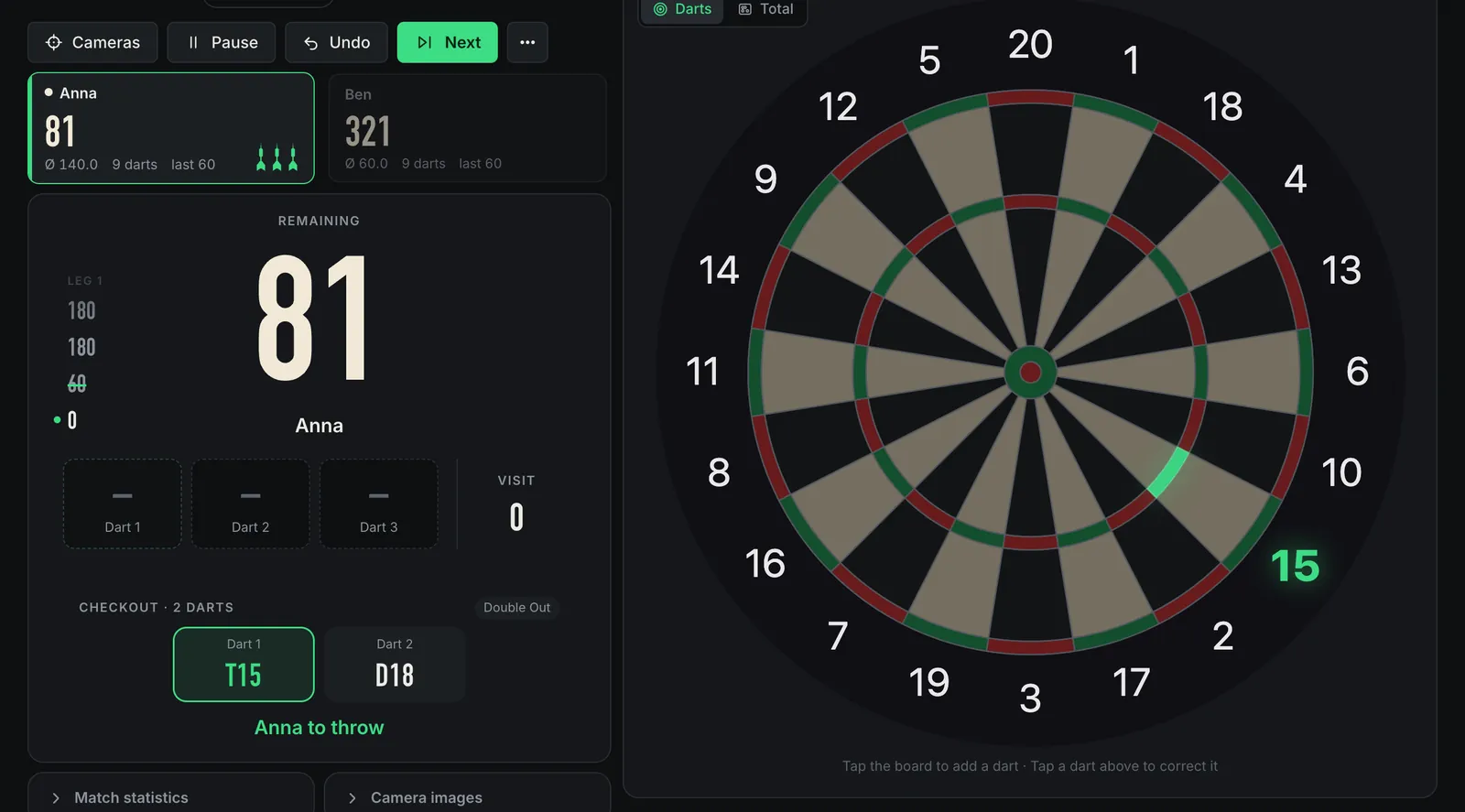
Double out means the dart that takes you to zero must land in the double ring or the bullseye. With 32 left you need double 16, with 50 left the bullseye.
- 40double 20, known as tops
- 32double 16, the most popular finish
- 50the bullseye counts as double 25
- 2double 1, the smallest finish
- 170the biggest: T20, T20, bull
An odd score cannot be finished with one dart. First throw a single that leaves an even number: with 37 left, a single 5 leaves 32 for double 16.
Every route on one sheet. The checkout chart lists the standard finish for every score from 170 down to 2, with a calculator for any out mode.
One detail from the WDF rule book: the caller announces the score you need, such as 32, and never the double, so nobody tells you which field to aim at.
Sources: WDF Playing and Tournament Rules, 20th edition, rules 2.02 to 2.04 and 3.08.
Bust
When are you bust in darts?
You are bust when a turn would take you below zero, leave exactly 1 or reach zero without a double. The whole turn then counts nothing, your score goes back to where it was before the turn, and darts you have not thrown yet are lost.
The three ways to bust
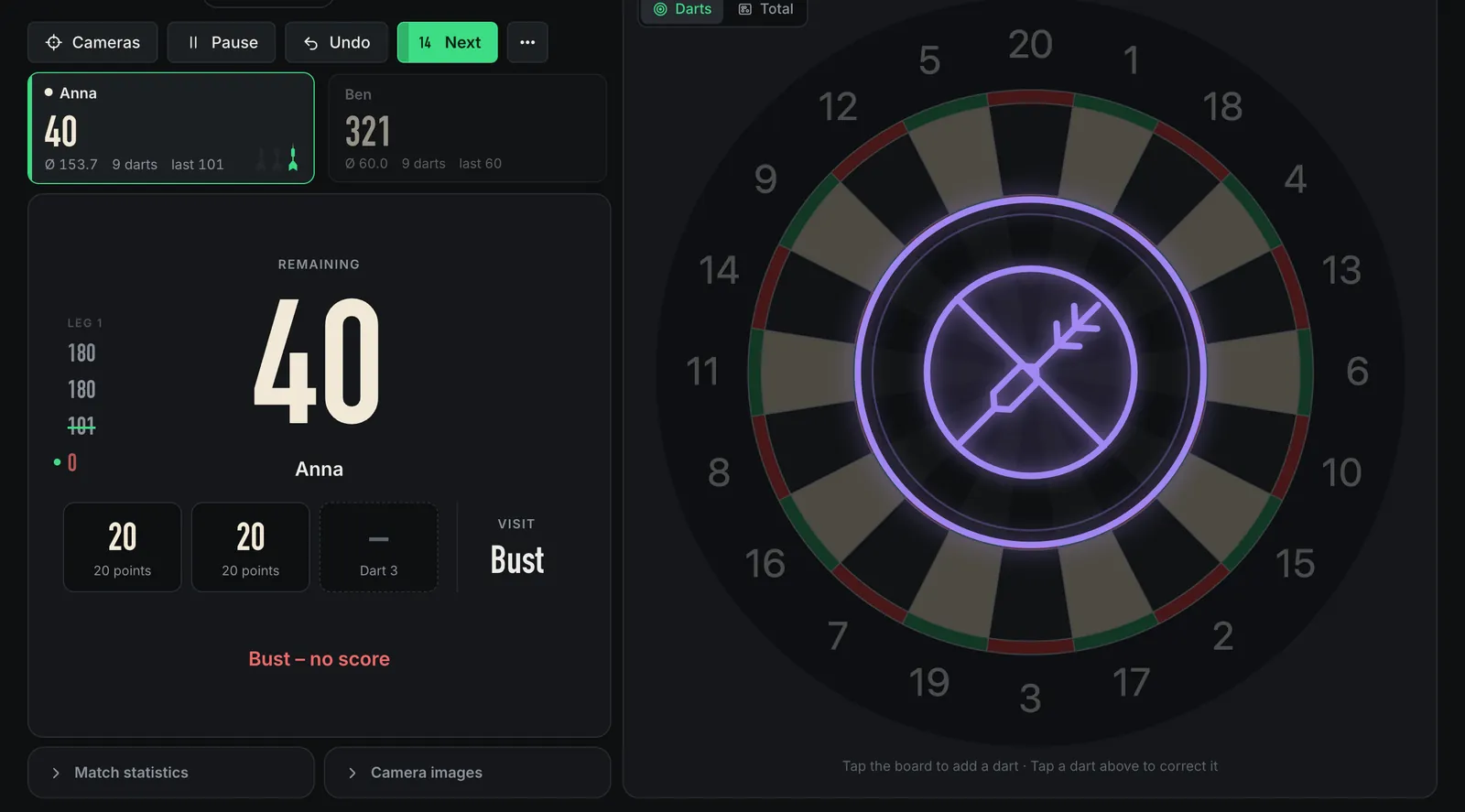
Why 1 left is bust. No double is worth 1, so the leg could never be finished from there. In single out, where any field finishes, 1 is a normal finish.
Sources: WDF Playing and Tournament Rules, 20th edition, rules 2.05.
Variants
What are double in, master out and single out?
They change how a leg starts or ends. Double in means your score only starts to count with a double, master out also lets a treble finish, and single out lets any field finish.
| Variant | To start scoring | To finish | Bust on 1 left |
|---|---|---|---|
| 501 double out (standard) | any dart | a double or the bullseye | yes |
| Double in double out | a double | a double or the bullseye | yes |
| Master out | any dart | a double, a treble or the bullseye | yes |
| Single out (straight out) | any dart | any field | no |
- Double in: darts before your first double score nothing. The double itself counts, so double 20 takes 40 off 301.
- Master out makes 57 a one-dart finish (treble 19) and raises the highest checkout to 180.
- Single out suits beginners and handicap games, since any dart can end the leg.
Each variant opens ready to play in Sridu: Double In Double Out, Master Out and Single Out. The checkout can also be set per player, so a beginner can play single out against a double out player.
Order of play
Who throws first in darts?
A bull-off decides: each player throws one dart at the bull, and the dart nearer the centre throws first. After that the start alternates from leg to leg.
- Order of the bull-offA coin toss or a draw decides who throws at the bull first.
- One dart eachThe dart has to stay in the board, otherwise it is thrown again.
- In the 25 or the bullseyeThat dart is taken out before the opponent throws.
- A tieBoth in the bullseye, both in the 25 or too close to call: throw again, in reverse order.
- After the bull-offThe winner starts legs 1, 3, 5 and so on, the opponent legs 2, 4, 6. In a set match the winner starts the odd sets.
In Sridu you choose this under Who throws first: the first player in the list, a bull-off or random. In each new leg the next player throws first.
Sources: WDF Playing and Tournament Rules, 20th edition, rules 12.01 to 12.03.
At the oche
Where do you stand when you throw darts?
Behind the oche, the throw line 2.37 m from the face of the board. You may not step on it, and if you stand to one side, your feet stay behind the line extended sideways.
- 1.73 mfloor to the centre of the bull
- 2.37 mboard face to the oche (steel-tip)
- 2.93 mbull to the oche on the diagonal
- 50 gmaximum weight of a dart, 30.5 cm maximum length
Soft-tip darts on electronic boards are usually thrown from 2.44 m. How to measure all of it at home is in the guide to dartboard dimensions.
Sources: WDF Playing and Tournament Rules, 20th edition, rules 1.01, 6.01 to 6.06.
Format
How do legs and sets work in darts?
A leg is one game of 501, a set is a group of legs, and the match goes to whoever wins the agreed number first. Best of 5 legs is the same as first to 3.
Under WDF rules a set or match is always played over an odd number, so it cannot end in a draw. Which formats the big tournaments use, from the World Championship down, is in darts sets and legs.
Sources: WDF Playing and Tournament Rules, 20th edition, rules 2.10, 2.11 and the definitions.
Cricket
What are the basic rules of cricket darts?
Cricket uses only the 15 to the 20 and the bull. Three marks close a number, further hits score points while an opponent still has it open, and you win with everything closed and at least as many points.
- Single = 1 mark, double = 2, treble = 3.
- Outer bull = 1 mark, bullseye = 2.
- Closed after 3 marks. Hits on a closed number score its value while someone still has it open.
- Win with all seven closed and no fewer points than anyone else.
Variants like Cut-Throat and the full scoring rules are on the Cricket page.
To print
Where can you get the darts rules as a PDF?
Right here: the PDF puts every rule from this page on one A4 sheet, ready to pin next to your board. It is free to print and share.
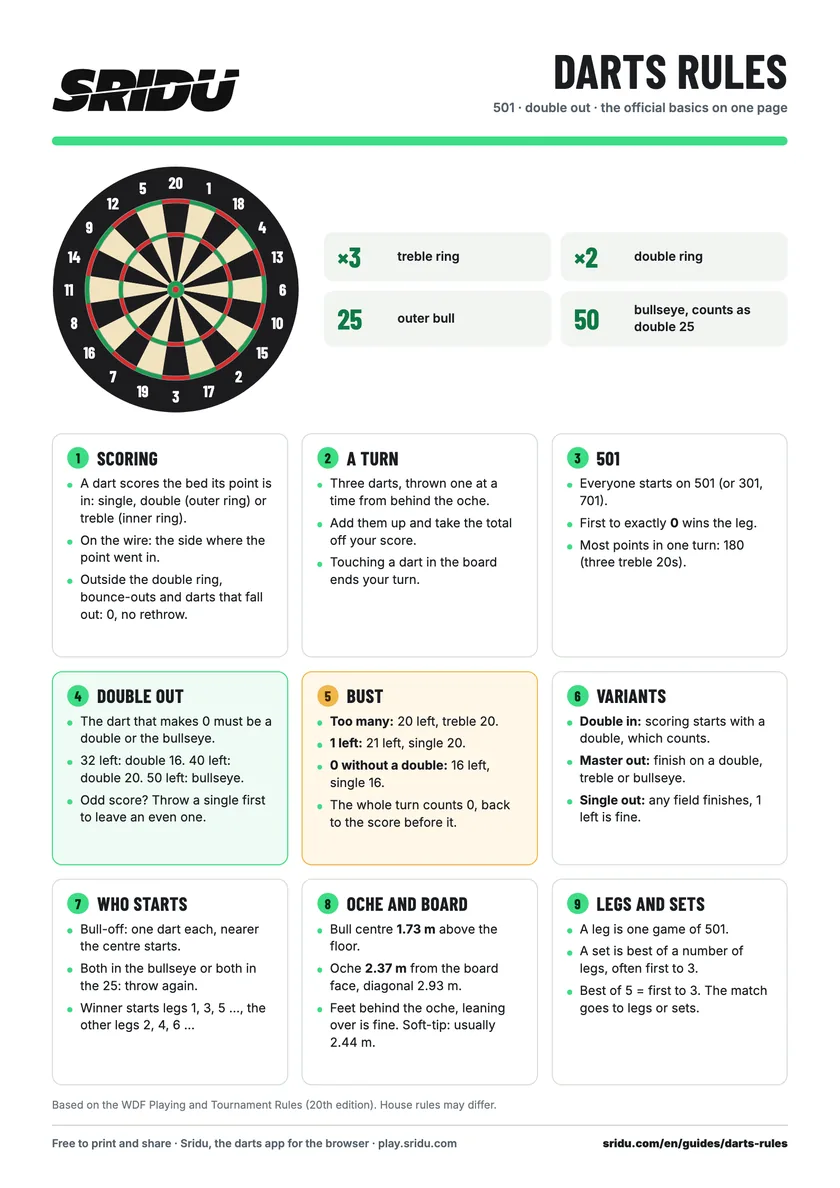
- Scoring, 501 and double out with a board diagram
- All three ways to bust
- Double in, master out, single out
- Bull-off and who starts each leg
- Oche, board height and legs and sets
FAQ
Questions about the rules of darts
Can you finish on the bullseye in darts?
Yes. The bullseye counts as double 25, so with 50 left it finishes the leg in double out. The outer bull (25) is a single and does not.
Is 1 left a bust in darts?
Yes, in double out and master out. No double or treble is worth 1, so the leg could not be finished from there. Only in single out is 1 a normal finish.
What happens to the remaining darts after a bust?
They are not thrown. The turn ends, the score goes back to where it was before the turn, and it is the next player’s go.
Does a dart on the wire count?
Yes. It scores the bed on the side of the wire where the point went into the board. A dart that bounces off the wire and falls out scores nothing.
Can you rethrow a bounce-out?
No. A dart that bounces off or falls out of the board counts nothing and may not be thrown again in that turn.
Do you have to start on a double in darts?
Not in standard 501, which starts straight in with any dart. Double in is a variant, often played with 301.
Who throws first in the next leg?
The start alternates. The winner of the bull-off throws first in legs 1, 3, 5 and so on, the opponent in the even legs, whoever won the previous leg.
Guides
Related guides
Let the app keep the rules
Sridu spots every bust, checks the double at the end of a leg and shows a checkout route for what you have left. Open it in the browser and play 501 against a friend or a bot. No account, nothing to install.