Guides · Dartitis · 13 min read
Dartitis: what it is, the symptoms and what helps
Dartitis is when you can no longer release the dart smoothly: your arm stops at the point of release, pulls back again and again, or the dart jerks out of your hand. Nobody fully understands it yet, but many players get a freer throw back with a new routine, practice without pressure and the right help.
In short
- What it is: the release locks, jerks or comes too early, often after years of smooth throwing.
- Why: somewhere between performance anxiety and a movement disorder of one practised skill, often a mix.
- What players try: a new trigger, a fixed rhythm, throws with eyes closed and practice with nothing at stake.
- Get help if it lasts for months, spreads to other tasks or comes with cramp or pain.
The basics
What is dartitis?
Dartitis is a problem with letting go of the dart. The throw starts as usual, then the arm freezes, pulls back once more or lets go with a jerk, and willpower alone doesn’t fix it.
It belongs to the same family as the yips in golf putting or cricket bowling: a movement you have repeated thousands of times suddenly stops running on its own. It is mostly described in experienced players.
If you want to compare with a free release, the guide on how to throw darts shows the full movement. The darts mental game covers routine and nerves in general; this page goes deeper into dartitis itself.
General information, not medical advice. This page sums up what players describe and what research says so far. If your hand cramps or twists, or the problem doesn’t go away, talk to a doctor.
Symptoms
What are the symptoms of dartitis?
The typical sign is a release that no longer happens by itself: you know when the dart should leave your hand, and it doesn’t. Players describe it in different ways, and many have more than one of these.
- Freezing at the releaseThe arm stops just before the dart should go and won’t move on.
- Extra draw-backsYou pull back two, three or more times before you can let go.
- A jerky releaseThe dart jumps out of the hand with a twitch, often low or wide.
- Too early or too lateThe dart slips out during the draw-back, or you push it out after the moment has gone.
- Fingers that clampThe fingers grip the barrel too hard and won’t open in time.
- Worse when it countsIt often shows first on doubles, in matches or when someone is watching.
How it often develops
- Now and thenA small hitch on a match double.
- Under pressureExtra draw-backs in matches and in front of others.
- In practice tooIt creeps into practice, even when you are alone.
- Most dartsIn bad phases it affects almost every throw.
This is a common pattern in players’ accounts, not a fixed course. Not everyone goes through every stage, and many have better and worse phases.
Causes
What causes dartitis?
The exact cause of dartitis is not known. Research on the yips in golf describes a range: performance anxiety (choking) at one end, and at the other a task-specific dystonia, a movement disorder in which muscles tighten on their own during one highly practised movement.
Most players sit somewhere in between, and the two sides feed each other. A 2024 review of dystonia in sport lists darts among the sports where it has been described.
Closer to anxiety
- Mainly in matches, on doubles or with people watching
- Much better when you throw alone and relaxed
- Racing thoughts, a fast pulse, fear of the miss
Closer to dystonia
- It happens in relaxed practice as well
- Fingers or wrist cramp, curl or twitch on their own
- Only this one movement is affected, at least at first
Telling the two apart is hard, even for specialists, and the signs overlap. A neurologist who works with darts players told Dartsnews he sees dartitis as a neurological problem in which the mind plays a part. That is one expert view; the research is not settled.
Players who have spoken about it
- Eric BristowThe five-time world champion developed dartitis in late 1986, and it shaped the rest of his career (The Week).
- Gian van VeenTold Sky Sports in January 2026 that he had dartitis about four years earlier, before he won his tour card. He reached the World Championship final that season.
- Jules van DongenWent public in March 2026 after a long search for help, now works with a neurologist and has started again with his other hand (Dartsnews).
Research
What is known about dartitis, and what isn’t?
Very little is proven. Research on the yips is still thin, most of it is about golf, and much of it consists of case studies with a handful of people.
- 25studies on the yips in sport found by a 2015 systematic review, 18 of them on golf
- 74people in 31 treatment studies on dystonia in sport, in a 2024 review
- 0randomised controlled trials in that review, so no treatment is proven
Fairly clear
- It is real and not a lack of willpower
- It hits a highly practised movement, often only that one
- Pressure makes it worse for most players
- The same problem exists in golf, cricket, baseball and music
Still open
- How many darts players have it: there are no reliable figures
- Why it starts in one player and not another
- Which treatment works best
- Whether, and when, it goes away by itself
Sources: Smith et al. (2003), The yips in golf: a continuum between a focal dystonia and choking, Clarke, Sheffield and Akehurst (2015), The yips in sport: a systematic review, Nijenhuis et al. (2024), Treatment of task-specific dystonia in sports, British Psychological Society, Research Digest on the yips.
What helps
What helps against dartitis?
No single fix works for everyone. The approaches players report most often share one idea: they change how the release is triggered, so the old hitch has nothing to latch on to.
Try one change at a time and give it a few weeks before you judge it.
- A new triggerLet go on a count, a word or the end of a breath out, not when it “feels right”.
- A fixed rhythmThe same tempo for every dart, for example exactly one draw-back. Some players do better throwing a little quicker.
- Eyes closedFrom close range at the middle of the board, so you feel the release without judging the result. Only with nobody near the board.
- No targetThrow at the blank board or a big field. No aim, no score, just the movement.
- Grip or set-upA different grip, barrel or weight can make the movement feel new. Change one thing at a time.
- The other handA few players start again with the other hand. It is a big step and a long way back to their old level.
- A breakA few weeks without matches takes the pressure out. Some come back freer, for others nothing changes.
- Help from othersA coach sees your throw from outside, a sport psychologist helps with fear and routine, a doctor checks for dystonia.
Don’t fight it dart after dart. Forcing your way through the hitch for an hour usually adds tension. Stop the session, do something else and come back another day.
Film yourself from the side, at normal speed and in slow motion. You often see where the arm stops more clearly than you feel it.
Step by step
How do you get your release back, step by step?
Start where the release still works, then add distance, targets and pressure back one at a time. Move on only when the current step feels free, even if that takes weeks.
- Watch and write downFilm your throw and note when it happens: alone, in matches, on doubles, late in a long session.
- Take the pressure offPause league matches for a while if you can, and tell your team why. Hiding it costs energy.
- Start closeThrow from about a metre with a new trigger and a fixed rhythm, at the middle of the board.
- Move back in stages1.5 m, 2 m, then the oche. Go back a stage whenever the hitch returns.
- Add targets, then a scoreBig fields first, then a game like Around the Clock, then a score you care about.
- Add a little pressureA small bet with a friend, an easy bot, a short league match. Setbacks along the way are normal.
Practice
How can you practise with dartitis without pressure?
Practise the release where nothing is at stake: alone, without a scoreboard to worry about and with a rhythm you can count. Keep sessions short and stop while the throw still feels good.
The count drill
- OneAim, eyes on one small spot.
- TwoDraw back, once.
- ThrowLet go on the word, whatever happens.
Say it out loud at first. Once it runs by itself, count in your head, and keep the same tempo on doubles as on the treble 20.
Low-pressure practice in Sridu
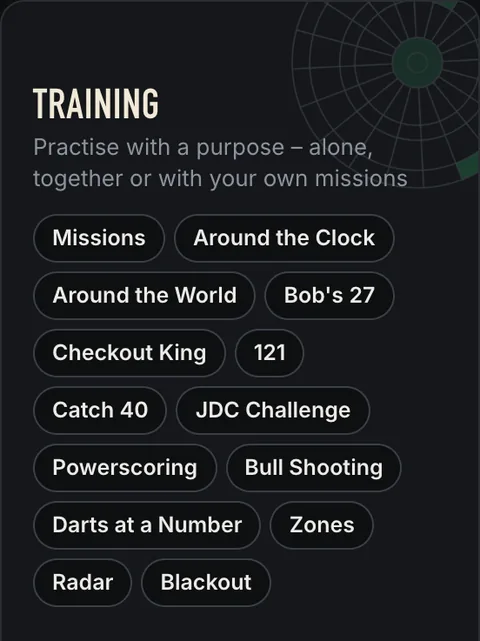
If you practise with Sridu, a few choices keep things calm. Around the Clock and High Score have no bust and no double to finish, so each dart is just the next dart, and the app counts for you while you watch your release.
- Switch off the caller and the sounds in the settings if they make you tense.
- Later, add a bot opponent with a low average you set yourself, so a match feels friendly.
- Leave the statistics alone in a bad phase. The numbers will still be there later.
More calm games are in solo darts games, and the darts practice app page shows every training mode. No app treats dartitis; it can only take the counting off your hands.
Getting help
When should you see a doctor or sport psychologist?
See a doctor if the problem lasts for months despite changes, or if your hand cramps, twists or trembles. Talk to a sport psychologist if fear of the throw starts to take over your darts or your mood.
Get it checked if
- It hasn’t eased after a few months of patient changes
- It happens even when you throw alone and relaxed
- Fingers or wrist cramp, twist, curl or tremble
- It spreads to writing, typing, using a mouse or other everyday tasks
- Pain, numbness or tingling come with it (see darts pain)
- You dread playing, avoid matches or feel panic at the board
Who helps with what
- GP and neurologistYour GP can refer you to a neurologist who knows movement disorders. Treatments used for dystonia, such as botulinum toxin injections, have been tried in sport too, with mixed results in small studies.
- Sport psychologistWorks on fear, pressure and routine. In the UK “sport and exercise psychologist” is a protected title, so check the HCPC register.
- CoachLooks at your throw from outside and helps you rebuild trigger, rhythm and grip step by step.
Bring a video. Dartitis rarely shows in a consulting room, so take a short clip of your throw, filmed from the side, to the appointment.
FAQ
Questions about dartitis
What is dartitis in darts?
Dartitis is a problem with releasing the dart: the arm freezes at the point of release, pulls back several times or lets go with a jerk. It is the darts version of the yips and mostly affects experienced players.
Can dartitis be cured?
There is no guaranteed cure, but many players get their release back or learn to play well with it. Gian van Veen had it before he won his tour card and later reached a World Championship final. Others need professional help, and some never quite reach their old level.
How long does dartitis last?
It varies from weeks to years, and there are no reliable figures. Patient changes to trigger and rhythm, less pressure and early help are what players most often credit, but nobody can predict how long it will take.
Is dartitis all in your head?
Not only. Anxiety plays a big part for many players, but some cases look like a task-specific dystonia, where the muscles tighten on their own. Most are a mix, which is why a doctor and a sport psychologist can both be useful.
Does hypnosis help with dartitis?
There is no good evidence either way. We found no controlled study of hypnosis for dartitis, and reports from golf come mostly from hypnotherapists themselves. If you try it, choose a qualified practitioner and keep working on your routine at the same time.
Should I switch to my other hand?
A few players have done it, and the movement feels free again because it has no history. It means starting almost from scratch, so try changes to trigger, rhythm and grip first.
Can beginners get dartitis?
It is mostly described in players with years of experience. A beginner with a stiff or jerky release usually has a technique problem; the guide on how to throw darts is the better place to start.
Does the same thing happen in other sports?
Yes. Golfers call it the yips, especially when putting, and it is also known in cricket bowling, baseball throwing and among musicians, where it is called musician’s dystonia.
Guides
Related guides
Calm practice, counted for you
Around the Clock and High Score in Sridu count your darts, so you can watch your release instead of the score. Caller off, no account, free for private use.