Guides · Darts corner · 13 min read
Darts room setup: how to plan a darts corner at home
A good darts corner needs a clear lane of about 3.5 m by 1.5 m, wall protection that reaches well past the board, light from more than one side and a mat on the floor. Plan it like a small room: the board wall, the throwing lane, a spot behind the oche for whoever is waiting and a place where everyone can read the score.
In short
- 3.5 × 1.5 m of floor, with no door or glass in the lane.
- Wall protection about 1 m square catches far more misses than a surround alone.
- Light from two sides or a ring light, neutral white, nothing shining into your eyes.
- A mat that starts at the wall saves the floor and your points.
- The score at eye level on the side, outside the miss zone.
Space
How much space do you need for darts?
You need a clear lane about 3.5 m long and at least 1.5 m wide. That is the 2.37 m throw, a metre behind the oche to stand and step back, and a few centimetres for board and surround.
Add room behind the thrower for anyone waiting, and the corner is complete. The plan below shows what goes where.
- Spectators behind the lineNobody stands between the oche and the board. The safe spot is behind the thrower, or to the side further back than the oche.
- Doors behind, never in the laneA door that opens into the lane lets someone walk into a flying dart. If it can’t be moved, lock it while you play.
- No glass near the boardBounce-outs fly sideways and back. Keep windows, pictures and cabinets with glass out of the first metre around the board.
- Two boardsGive each its own lane. With 1.5 m per lane the board centres end up at least 1.5 m apart, more if a screen hangs between them.
The exact height and how to measure the throw line are in the guide to hanging a dartboard. Here the topic is everything around it.
Which room
Where is the best place for a darts corner?
The best place has a solid wall you don’t share with neighbours, a floor that can take a dropped dart and a lane nobody has to cross. A garage, a cellar or a spare room usually tick all three; a living room works with a little more care.
| Place | Good | Watch out for |
|---|---|---|
| Cellar or hobby room | Solid walls, quiet for the neighbours | Low ceilings, damp air for a bristle board, often little light |
| Garage | Lots of space, robust floor | Cold and damp in winter, concrete blunts dropped points |
| Living room | Warm, close to everyone | TV, glass and a sofa in the lane; family walking through |
| Hallway | Long and narrow, often just right | Doors opening into the lane, people passing |
| Spare room or loft | A corner of your own that can stay set up | Ceiling slopes, floor noise for the rooms below |
Neighbours below or next door? Pick the wall and floor with noise in mind before you drill. The guide to a quiet dartboard shows which wall is best and how to decouple the board.
Wall protection
Which dartboard wall protection catches the most misses?
A backboard of about 1 m square catches almost every miss at home. A surround covers the ring just outside the double, where most misses land, so for a good player it is often enough.
Beginners and children spray wider. That is where a larger panel saves the wall.
- Surround, about 70 cmCatches the near misses. Light, cheap and it takes no drilling beyond the board bracket.
- Backboard, about 1 mCatches the wider ones too, and gives you a base for light and camera mounts.
- Large panel, 1.2 m and moreFor beginners, party nights and children’s games.
Cork, wood, felt or foam: what each material does
| Material | Darts | Good for | Downside |
|---|---|---|---|
| EVA or PU surround | Stick or drop softly | Every board, the first thing to buy | Covers only about 12 cm round the board |
| Cork | Stick and stay put | DIY backboards, quiet | Crumbles where it is hit most; tiles can be swapped |
| Plywood or MDF alone | Stick in softwood, bounce off hard boards | A base under cork or felt | Hard, loud and it dulls points |
| Felt over cork or foam | Go through and stay | A tidy look in the living room | Thin felt alone stops nothing |
| Acoustic slat panels | Dent and splinter the slats | Sound and looks around the corner | Keep them outside the miss zone |
| Cabinet | Hit the open doors | Hiding the board, chalkboards inside | Doors cover only a little beside the board |
Rubber or foam spacers behind a panel also keep the knock out of the wall. A board that has had a hard life on the double ring is covered in the guide to dartboard care.
Build it yourself
How do you build a dartboard backboard yourself?
Glue cork onto a plywood panel about 1 m square, cover it with felt if you like and hang it on the wall with spacers. It takes an afternoon and costs roughly 40 to 90 euros.
What you need
- Plywood, 15 to 18 mm, about 100 × 100 cm (the hardware store cuts it to size)
- Cork, at least 10 mm in total: a roll or tiles, two layers are better
- Contact adhesive or tile adhesive for cork
- Felt and a staple gun, if you want a cloth finish
- Rubber spacers, wall plugs and screws that suit your wall
Six steps
- Mark the centreDraw the diagonals on the panel. The board bracket goes where they cross, so the board sits in the middle.
- Glue the corkLay the layers with staggered joints, press them flat and let the glue cure.
- Cover itStretch felt over the front and staple it at the back. Dark colours hide holes longest.
- Fit the spacersGlue rubber pads to the back at the corners and the middle, so the panel never touches the wall.
- Hang the panelA 1 m panel of 18 mm plywood alone weighs around 10 to 12 kg. Use plugs made for your wall, into studs on plasterboard.
- Hang board and surroundBracket on the centre mark, board with the 20 on top, then the surround over it.
The board face moves forward. Panel, cork and spacers add a few centimetres, so check the height and measure the oche again afterwards, as described in hanging a dartboard.
Lighting
What is the best lighting for a dartboard?
The best dartboard lighting comes from more than one side and from in front of the board, so darts cast no shadow on the next target. An LED ring light around the board does that in one piece; two spots on the ceiling a little way out, angled in from left and right, do it too.
- Ring lightFits round the board or onto the surround. Even light from every side, and many have holders for cameras.
- Two spotsOn the ceiling, about a metre in front of the board, one from each side. A single spot always leaves shadows.
- Battery or mainsBattery rings need no socket but have to be charged, and some dim as they run down. For long sessions or cameras, take one on mains power.
- Neutral whiteAround 4000 K keeps red and green segments easy to tell apart. Very warm light makes them muddy.
- No glareFrom the oche you should see the board, not a bulb. Shield spots and point them at the board, never down the lane.
- Steady lightCameras need light that doesn’t flicker or change. Close the curtains if sun reaches the board.
Want to add cameras later? A ring with camera holders is the tidiest base, and the guide to a DIY camera dartboard explains the rest.
Floor
Which dart mat should you buy?
Buy a mat about 3 m long with the oche printed on, so it covers the floor from the wall to behind the throw line. Rubber lies flat and stays put; carpet mats are lighter and roll up after the game.
Rubber mat
Stays down
- Lies flat, doesn’t slip
- Wipes clean, takes years of drops
- Heavy, smells at first
- Hard to roll up
Carpet mat
- Light, rolls up for storage
- Quiet and soft
- Can slip without an underlay
- Edges curl over time
- With ochePrinted lines, often for steel-tip and soft-tip distances. A raised oche lets your toes feel the line.
- 60 or 80 cm wide60 cm is enough for one thrower. Wider mats leave room to step aside and cover more of the drop zone.
- Under the boardMost dropped darts land right below the board. Tiles chip, parquet dents and concrete blunts the points.
- On carpetA mat still helps. It keeps the line in place and saves the carpet from holes under the board.
Check the printed line. Mats assume the board face is on the wall, but a surround or backboard brings it forward. Measure from the board face and tape a new line if needed, as the guide to hanging a dartboard explains.
Scoreboard and extras
Where should the scoreboard go in a darts corner?
Hang the score at eye level on the board wall or the side wall, beside the board but outside the miss zone. From the oche you should read it with a quick glance, without turning your head away from the board.
- Score at eye levelA tablet in a wall mount, a screen or a whiteboard. At least a hand’s width outside the surround.
- ChalkboardThe classic. Keep chalk and sponge on a ledge below it, away from the board.
- Dart holderOn the wall near the oche or on a shelf behind it, so nobody leaves darts on the floor.
- PowerA socket near the board for the light and the tablet, cables in a channel along the wall.
- Drinks behind the lineA shelf or small table behind the oche, never in the lane.
- Room for camerasLeave about half a metre round the surround free if you might add camera scoring.
A tablet, laptop or TV as the scoreboard
A tablet next to the board makes a fine digital scoreboard. With an app like Sridu, a free online darts scorer that runs in the browser, you tap each dart or type the total of the visit, and it works out the rest, the checkout included.
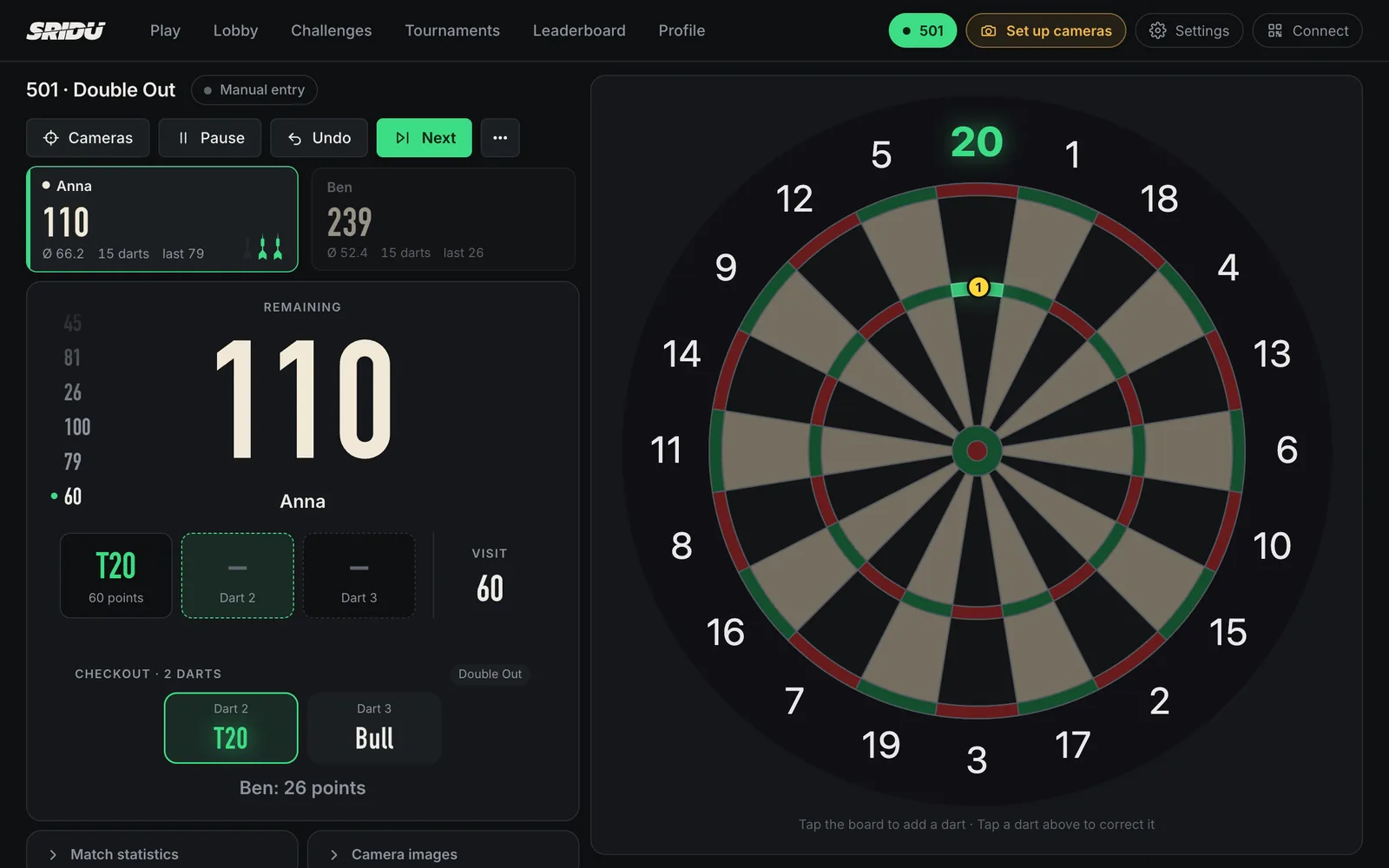
- Tablet at the boardEnter the visit while you pull your darts, so nobody walks back and forth.
- Laptop on the TVConnect a laptop to the TV with HDMI and the whole room can follow the match.
- Phone as a second screenScan the QR code and a phone shows the match live, and if you allow it, it can enter darts too.
Cameras can come later: Sridu can also score with one to four ordinary USB webcams, which is what the room around the surround is for. How to build that is in the DIY camera dartboard guide.
Budget
How much does a darts corner cost?
Without board and darts, a basic corner costs about 50 to 70 euros for a mat and a surround. With a backboard, a ring light and a holder for the score, plan on roughly 150 to 300 euros.
| Part | Price range | Note |
|---|---|---|
| Dart mat with oche | 35 to 65 € | Rubber or carpet, about 3 m |
| Surround | 15 to 60 € | EVA is cheaper, pressed PU lasts longer |
| DIY backboard | 40 to 90 € | Plywood, cork, felt, spacers |
| LED ring light | 25 to 100 € | More with camera holders |
| Tablet wall mount | 10 to 30 € | Or a shelf you already have |
| Chalkboard or whiteboard | 10 to 30 € | Plus chalk or pens |
| Dart holder | 5 to 25 € | Wall or stand |
- About 60 €Mat and surround. Enough for one player who mostly hits the board.
- About 150 €Plus a ring light and a tablet mount. Shadow-free and with a digital score.
- About 300 €Plus a DIY backboard, chalkboard and holder. Ready for guests and beginners.
Rough ranges from common online shops, as of October 2026, without board, darts and a tablet. Prices vary a lot between shops and brands.
Checklist
Darts corner checklist
Go through this list before the first evening with friends. If every box is ticked, the corner is safe, bright and easy to play in.
- Lane of about 3.5 × 1.5 m, nothing on the floor
- No door opening into the lane, no glass within a metre of the board
- Surround fitted, backboard or larger panel for beginners
- Board face measured again after the panel went up
- Light from two sides or a ring light, no shadows on the treble 20
- No bulb visible from the oche
- Mat from the wall to behind the oche, line checked
- Score at eye level, outside the surround
- Dart holder and a place for drinks behind the line
- Socket and cables tidy, a free ring round the board for cameras
Throw distances: WDF Playing and Tournament Rules, 20th revised edition. Space, materials and prices are practical guidance for home use.
FAQ
Questions about a darts corner
How much room do you need to throw darts?
A lane about 3.5 m long and 1.5 m wide. The throw itself is 2.37 m from the board face; the rest is room to stand behind the line and for misses to the side.
Can I set up a darts corner in a small room?
Yes, if the room is at least about 3.5 m long in one direction. Width is less critical: 1.5 m is enough for one board, and a wide backboard keeps narrow side walls safe.
Is a surround enough to protect the wall?
For a steady player, mostly yes, since most misses land just outside the double ring. Beginners, children and party nights miss wider, so add a backboard of about a metre square.
What is the best light for a dartboard?
An LED ring light round the board, or two spots on the ceiling slightly in front of the board, angled in from both sides. Pick neutral white and make sure no bulb shines into your eyes from the oche.
Do I need a dart mat on carpet?
It still helps. It marks the line where it can’t move, takes the dropped darts under the board and keeps the carpet free of holes.
Where do spectators stand when playing darts?
Behind the thrower or to the side further back than the oche. Never between the line and the board, and never next to the board, where bounce-outs fly.
Where should I put a tablet for scoring?
At eye level beside the board, at least a hand’s width outside the surround. Players can then enter their visit while they pull their darts.
Your corner is ready. Who keeps score?
Put a tablet or laptop on the wall and open Sridu: tap your darts or type the visit, and it counts down, suggests the checkout and calls the score. It’s free and needs no account. When the cameras go up, it can score by itself.